
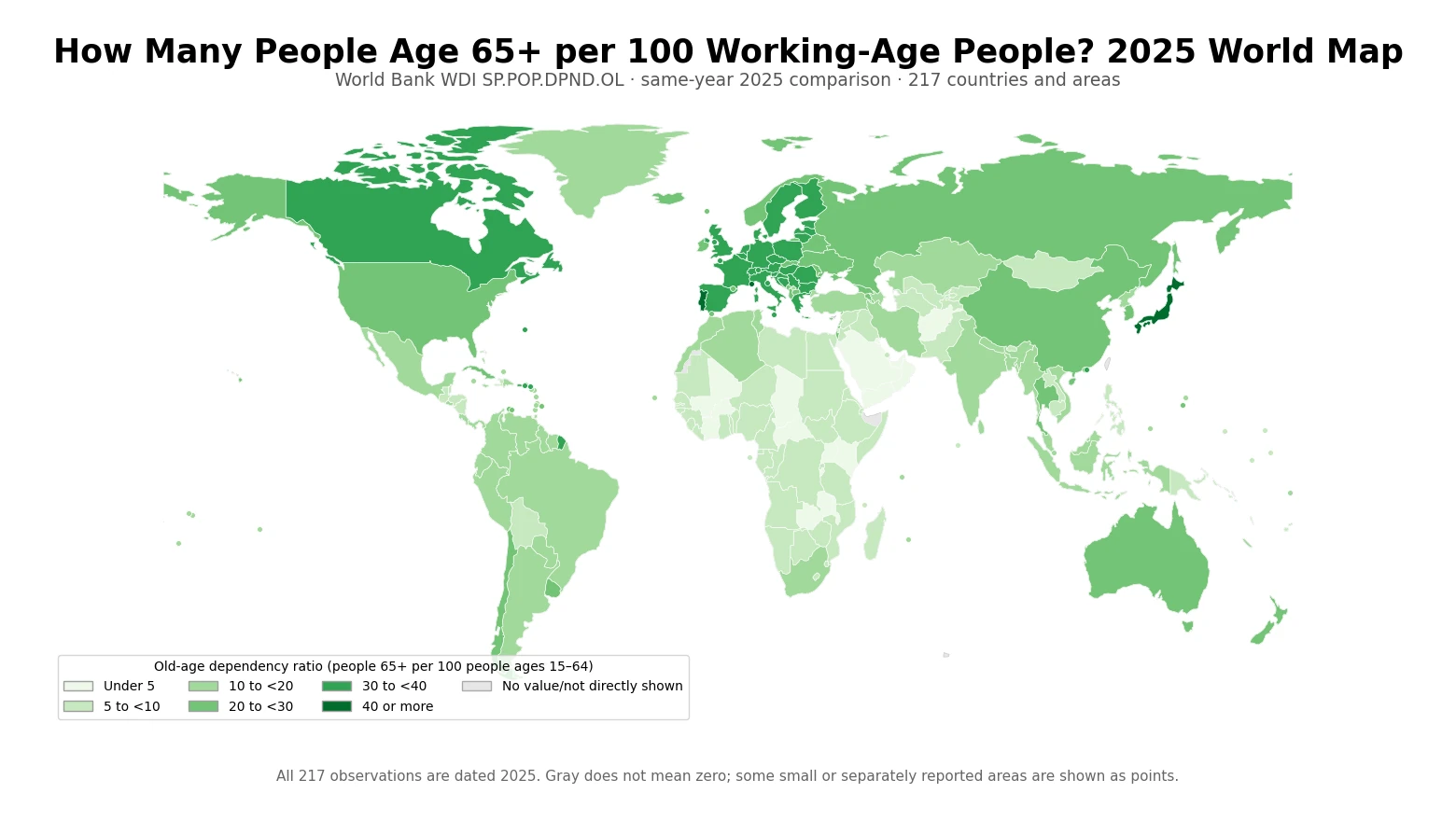
The old-age dependency ratio measures how many people aged 65 or older exist for every 100 individuals in the working-age group (15–64). Unlike total population percentages, this metric isolates the burden of supporting the elderly relative to the economically active population. The World Bank's 2025 dataset provides a consistent global comparison across 217 countries and areas, eliminating older data inconsistencies found in previous reports.
Global Distribution and Key Findings
Across the 217 observations, the median old-age dependency ratio is 12.7, with a mean of 16.8. The data reveals a wide spectrum: Qatar holds the lowest value at 2.0, while Monaco leads globally at 71.7. Japan follows closely behind at 51.0. While Europe and East Asia often share high ratios, they do not form a uniform block; for instance, Italy sits at 39.7, whereas South Korea is significantly lower at 29.3. The distribution shows that 68 countries fall between 5 and below 10, while only three nations reach a ratio of 40 or higher. It is crucial to note that this ratio reflects age structure, not actual pension pressure or economic dependency, as many elderly work and many working-age individuals are not in the labor force.
Data Integrity and Interpretation
A defining feature of this dataset is its uniform 2025 dating for all observations, ensuring comparability without mixing 'latest available' figures from different years. The map uses unweighted statistics, giving equal importance to each country regardless of population size. Small or separately reported areas appear as points due to resolution limits, but gray shading does not indicate zero data. To fully understand the implications of these numbers, one must combine them with employment rates and fiscal data, as the ratio alone cannot determine the economic reality of aging populations.


0 댓글