
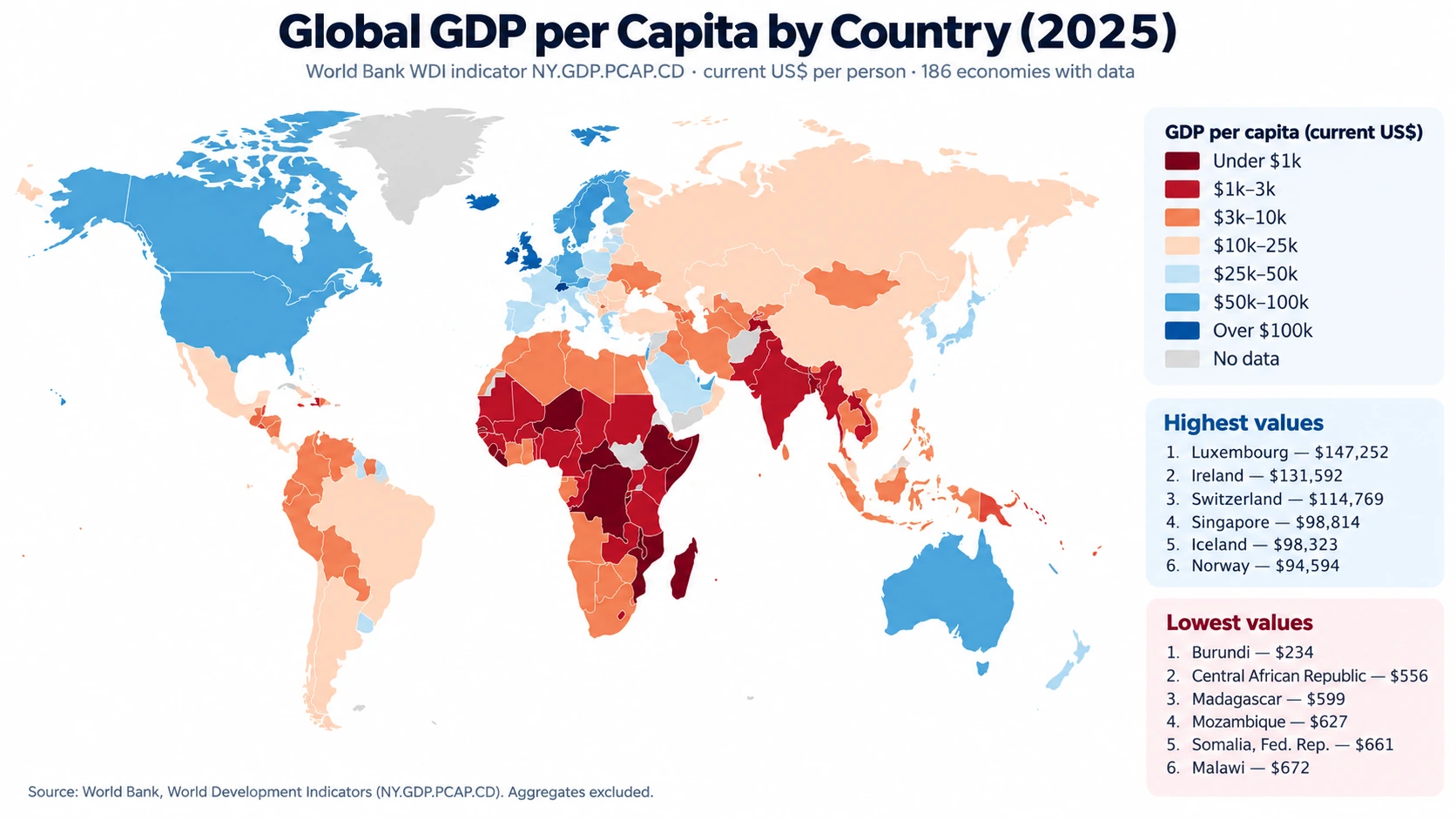
A 2025 analysis of global economic output reveals a stark disparity between nations, with the median income per person sitting at roughly $7,882 while the average reaches nearly $19,523 due to a handful of ultra-rich economies.
Extreme Disparities and Regional Clusters
The data highlights that a small number of high-value economies significantly skew the global average. At the top end, Luxembourg leads with approximately $147,252 per person, followed by Ireland at $131,592 and Switzerland at $114,769. In contrast, the lowest recorded value belongs to Burundi at just $234 per person, with other nations like Somalia and Malawi also falling below $1,000. This massive gap is best visualized through a map rather than a single number, as it illustrates how high-income clusters form in Western Europe, North America, and East Asia, while low-income concentrations dominate Sub-Saharan Africa. For instance, Singapore sits near $98,814, whereas India records only $2,702, demonstrating that total economic size does not equate to per-person wealth.
Understanding the Metric and Its Limitations
It is crucial to interpret these figures as nominal GDP per capita in current U.S. dollars, which divides an economy's total production by its population. This metric reflects differences in production levels, exchange rates, and prices but does not represent household disposable income or purchasing power. Consequently, the ranking should not be viewed as a direct measure of how much money an average resident takes home. For example, while China and India are among the world's largest economies in total output, their large populations result in lower per-person values compared to smaller nations like Luxembourg. The dataset covers 186 countries with 2025 observations, excluding regional aggregates, providing a snapshot of nominal economic output per person without implying direct comparisons of local living standards.
View the full dataset and methodology on World Bank Open Data


0 댓글