
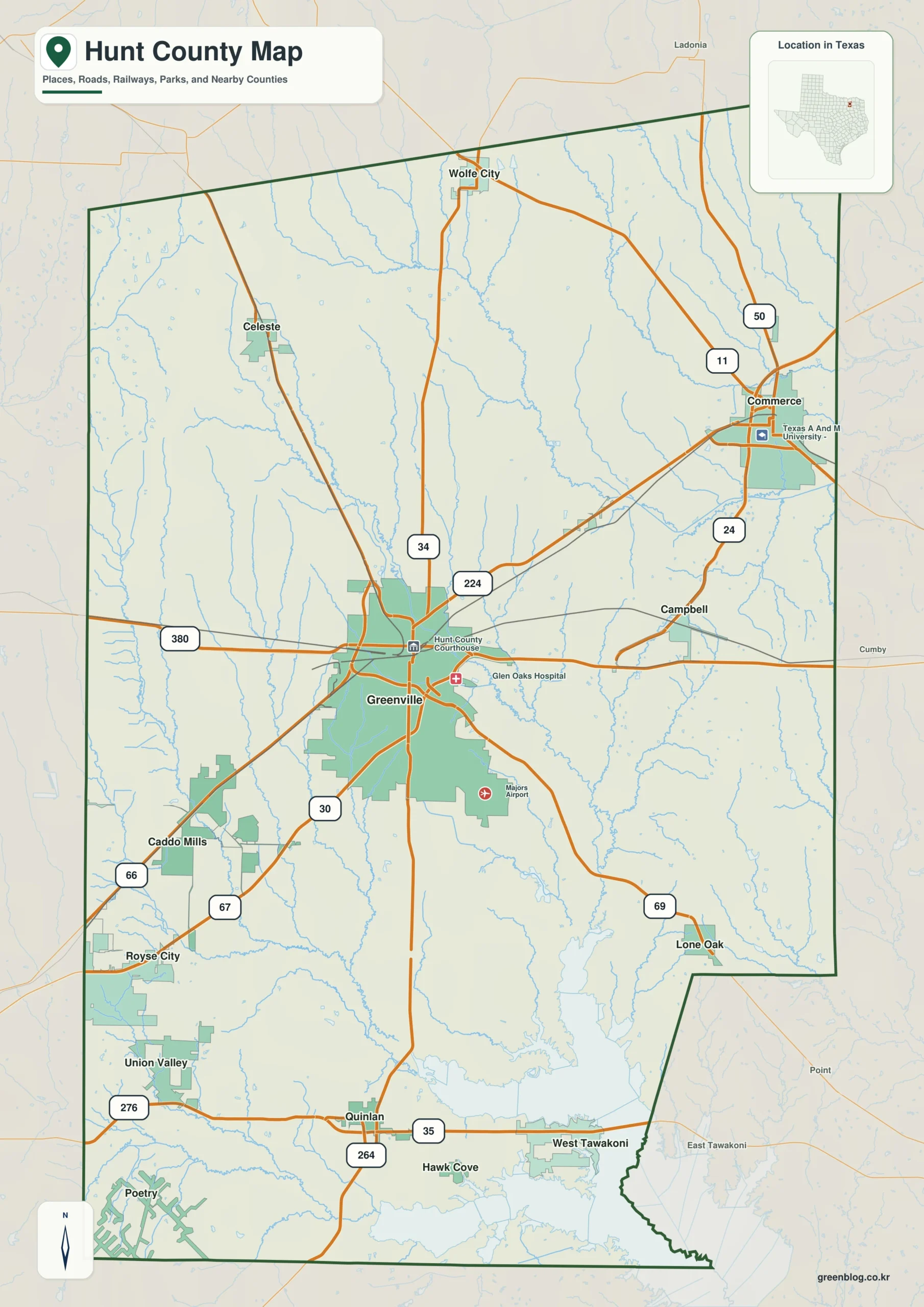
Hunt County, located northeast of Dallas, is best understood by observing how its central road hub contrasts with its dispersed northern, eastern, and southern communities. This region offers a unique geographic experience where major cities like Greenville and Commerce sit at distinct points in the landscape, connected by specific river systems and state routes.
The Road Network Centered on Greenville
Greenville serves as the clearest starting point for exploring the county's infrastructure. Situated slightly south of the county's midpoint, it acts as a practical orientation point because Interstate 30 runs through the city from the Caddo Mills and Royse City side before continuing eastward. From this central location, travelers can access other key areas via State Highway 224 heading toward Commerce, State Highway 34 leading north to Wolfe City, and U.S. 69 extending southeast toward Lone Oak. Surrounding Greenville are other significant settlements such as Caddo Mills to the southwest near the Dallas region, Campbell and Lone Oak to the east, and Quinlan, West Tawakoni, and Hawk Cove closer to the large water body along the southern edge. The layout of these routes demonstrates that local activity is distributed across several corridors rather than concentrated in a single block.
Settlement Patterns and Water Features
The county's geography is further defined by its settlement pattern and water systems. Six highlighted cities appear on the maps, including Greenville, Commerce, Caddo Mills, West Tawakoni, Quinlan, and Wolfe City. While specific population values are printed on the map data, the spatial arrangement tells a clear story: Greenville is central, Commerce occupies the northeastern edge near Texas A&M University-Commerce, and Wolfe City sits well to the north. The water landscape adds another layer of complexity, as the South and Middle Sulphur rivers cross the northern part of the county, while Caddo Creek and Sabine River tributaries organize drainage farther west and south. Communities like Quinlan and West Tawakoni occupy a different setting near Lake Tawakoni, separated from the main road network by these significant water bodies.


0 댓글