
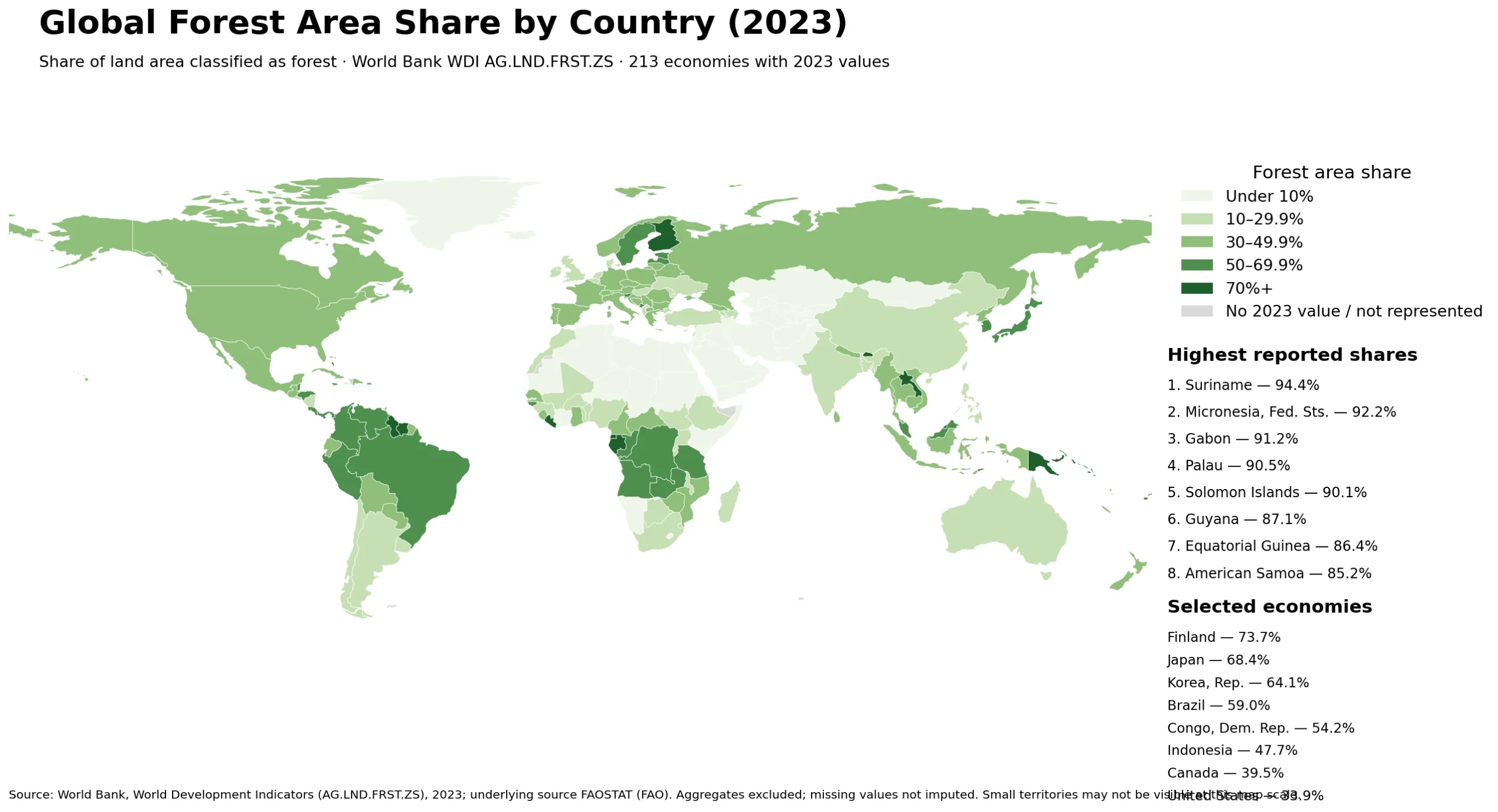
In 2023, a global comparison of forest area as a percentage of total land area reveals a vast disparity between nations where forests dominate the landscape and those where other ecosystems prevail. Based on World Bank data for 213 economies, the average forest share sits at approximately 31.7%, yet this single metric cannot explain the ecological reality or absolute size of any nation's green spaces.
The Spectrum of Forest Coverage
The distribution of forest density is highly uneven, with Suriname leading at 94.4% and Micronesia following closely at 92.2%. While these percentages indicate that a country's land is overwhelmingly classified as forest, they do not reflect the total square kilometers of trees. For instance, despite having a massive absolute forest area, countries like Brazil and Canada register lower shares due to their larger total land areas including non-forest regions. Conversely, 48 economies fall below 10% forest coverage, ranging from dry nations like Saudi Arabia to small urban territories like Monaco. It is crucial to understand that a reported zero or near-zero percentage does not mean the absence of trees; rather, it reflects the specific statistical definition used by the World Bank, which excludes agricultural plantations and urban gardens.
Contextualizing Major Economies
When examining familiar large economies, the range remains broad. Finland stands out with 73.7% forest coverage, while Australia registers significantly lower at 17.4%. Even within developed nations, differences exist; for example, Japan has 68.4% forest share compared to the United States at 33.9%. These figures measure land classification rather than ecological quality or management practices. A high percentage does not guarantee primary forests or biodiversity richness, while a low percentage does not necessarily indicate poor environmental stewardship, as deserts and grasslands naturally occupy significant portions of certain national landscapes.


0 댓글