
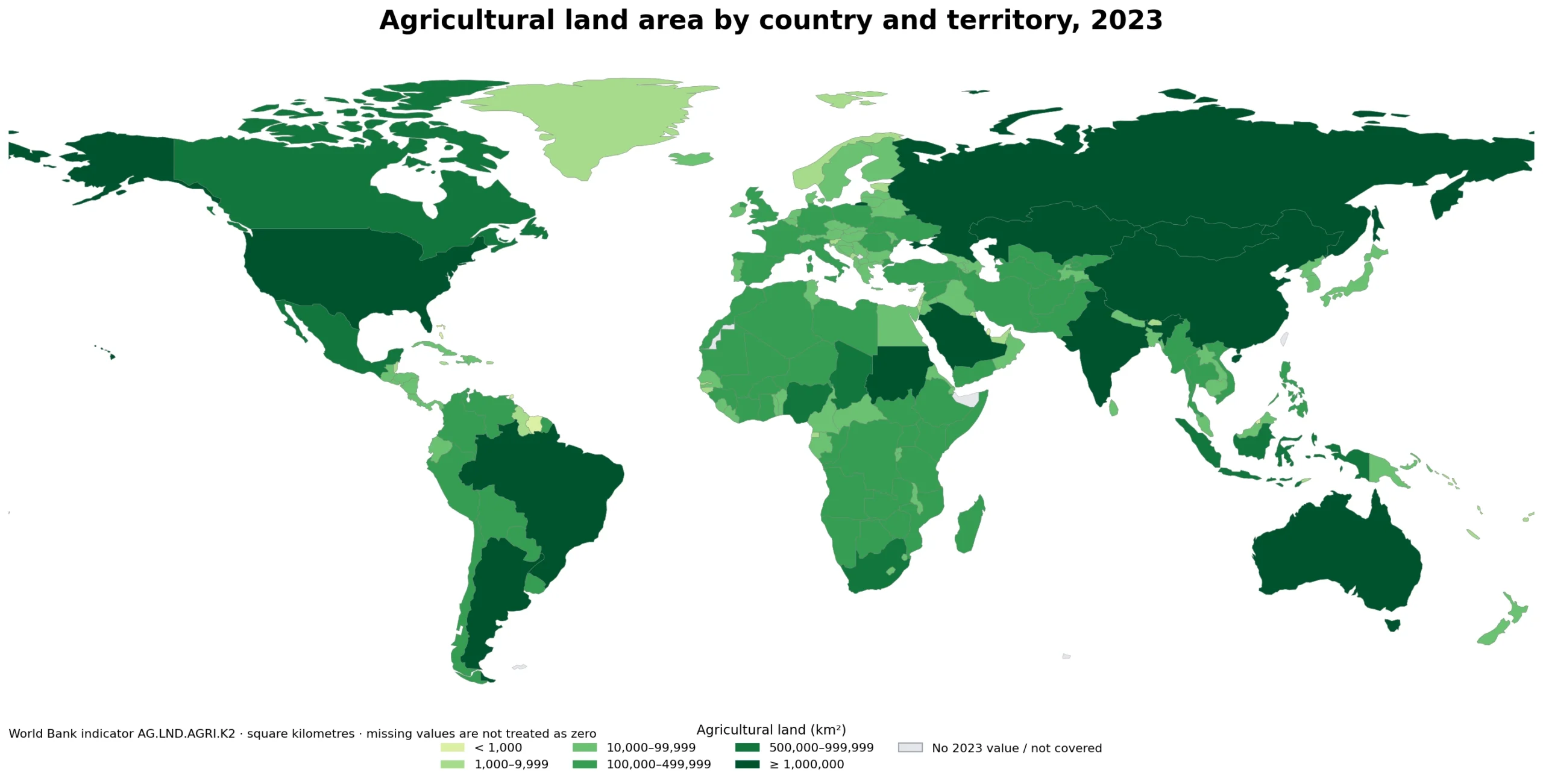
Agricultural land varies wildly across nations, ranging from massive continental holdings to tiny island territories. The World Bank's 2023 data reveals a distribution where the mean is skewed by giants like China, while the median reflects the reality of most countries.
The Scale of Agricultural Land in 2023
In 2023, China reported the largest agricultural land area at approximately 5.20 million square kilometers, followed by the United States with about 4.22 million square kilometers and Australia at roughly 3.63 million square kilometers. At the opposite end of the spectrum, many small island nations and city-states possess only a few dozen square kilometers of agricultural land. The dataset includes 217 country and territory rows, though eight entries lack 2023 observations and are excluded from calculations rather than filled with zeros. This results in a comparison based on 209 numeric values, where the median agricultural land area sits at approximately 28,730 square kilometers. The mean value is significantly higher at about 229,290 square kilometers due to the influence of very large countries. Eleven nations hold over one million square kilometers, while forty-four observations fall below one thousand square kilometers.
Defining and Interpreting Agricultural Land
The World Bank defines agricultural land as a combination of arable land, land under permanent crops, and permanent pasture. Arable land covers temporary crops, while permanent crops include long-term plants like fruit trees or vines without replanting after harvest. Permanent pasture encompasses land used for sustained grazing or forage. This definition is broader than simple cropland, explaining why countries with extensive dryland or grassland systems rank highly despite lower intensification. It is crucial to understand that this indicator measures the physical extent of land in square kilometers, not agricultural output, yields, income, or economic value. A large area indicates spatial extent rather than productivity; two nations can share similar land areas yet possess vastly different crop mixes, rainfall patterns, irrigation systems, and mechanization levels.


0 댓글