
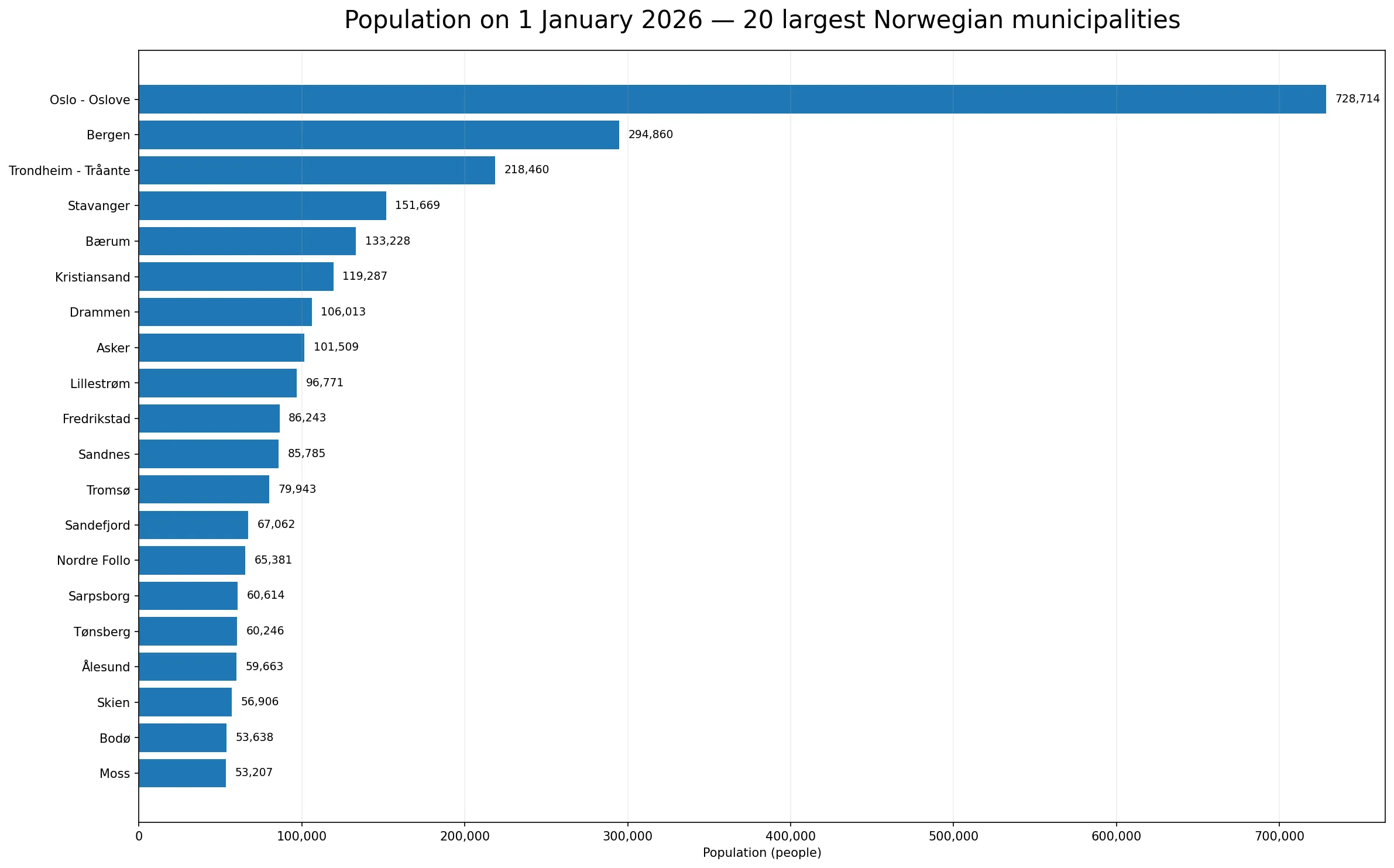
On January 1, 2026, Norway's 357 named municipalities span a staggering demographic range, from the massive urban center of Oslo down to the tiny hamlet of Utsira. While Statistics Norway records show a total population of over 5.6 million across all localities, understanding this distribution requires looking beyond simple averages to grasp the true scale of difference between the largest and smallest administrative units.
The Extreme Disparity in Population Size
The data reveals a highly skewed landscape where a handful of large cities dominate the population count. Oslo - Oslove leads with 728,714 residents, accounting for nearly 13% of the total, while Utsira sits at just 219 people. This massive gap means that the average population per municipality is misleadingly high at 15,763; in reality, half of all municipalities have fewer than 5,447 residents. The top twenty municipalities alone hold almost half of Norway's total population, demonstrating how urban concentration shapes the national demographic picture.
Contextualizing Small and Large Communities
At the other end of the spectrum, places like Utsira, Modalen, and Raarvihke - Røyrvik maintain their status as valid administrative entities despite having fewer than 500 residents. A population count does not reflect land area or economic density; a municipality can be small in people but vast in territory. The dataset confirms that all 357 named locations have recorded values, excluding only one unidentifiable entry labeled 'Unknown municipality.' By focusing on the median and quartiles rather than just the mean, we gain a clearer picture of what a typical Norwegian municipality looks like in 2026.


0 댓글