
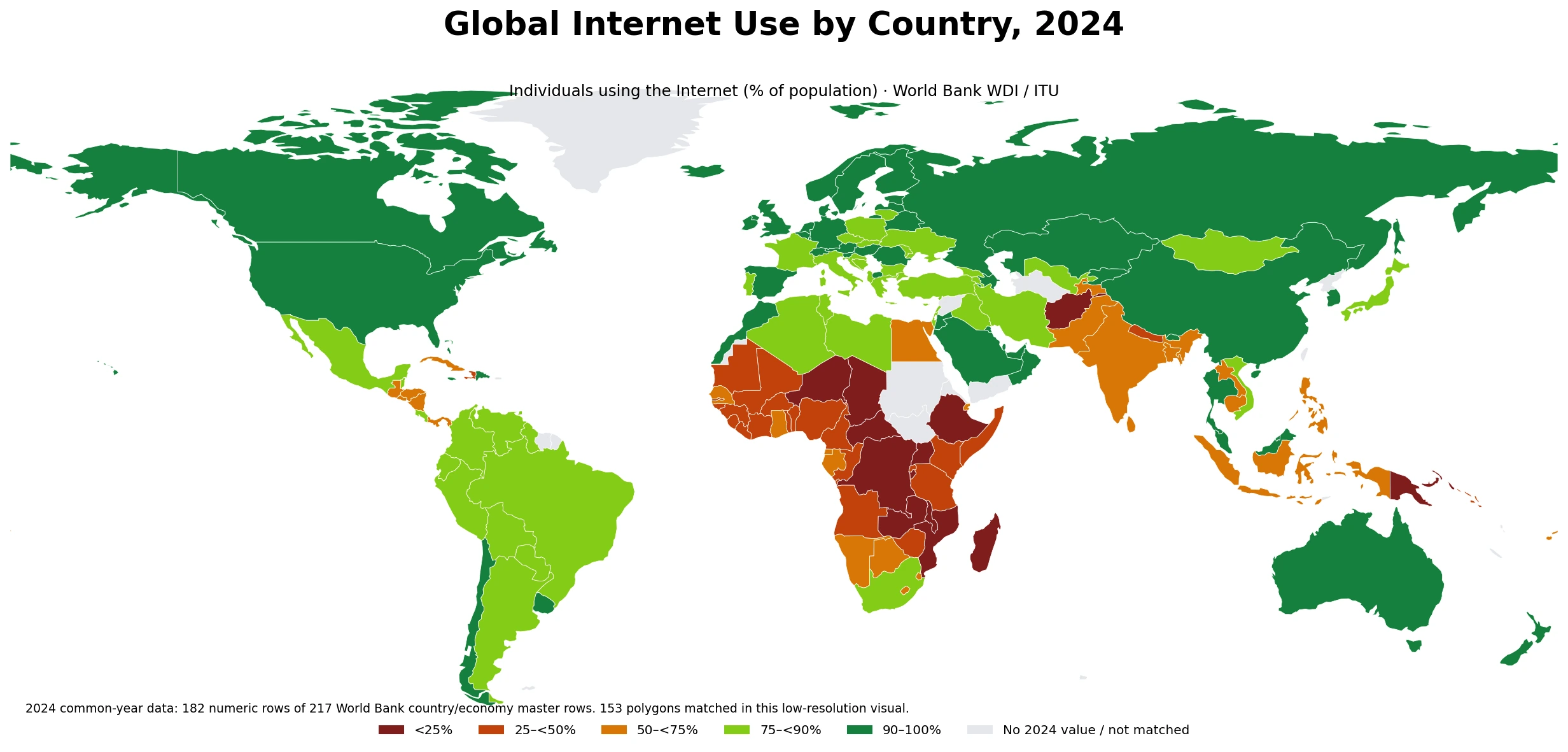
This analysis examines the percentage of individuals who used the internet from any location within the last three months across 182 countries and economies for the year 2024. Derived from World Bank data, it highlights significant disparities in digital usage rather than counting devices or subscriptions.
Defining Digital Usage and Data Integrity
The metric measures actual internet activity over a three-month period, distinguishing itself from broadband subscription counts which measure accounts rather than people. While the World Bank reports a weighted global average of 71.2% for 2024, this article utilizes an unweighted mean of 72.5% across 182 valid observations to describe the distribution of country-level data. Thirty-five entries remain missing from the dataset; these are recorded as NA rather than being filled with estimates or older years. The comparison strictly adheres to the 2024 reference year because 2025 reporting is incomplete for many nations, ensuring all statistics refer to a single common period.
Distribution Patterns and Regional Disparities
The data reveals a wide digital-use gap, with the median adoption rate at 82.1% while the lowest quartile sits at 59.4%. Thirteen countries reported usage rates below 25%, with Burundi leading at 8.6%, followed closely by Uganda at 8.9%. In contrast, only three economies—the United Arab Emirates, Bahrain, and Saudi Arabia—reported exactly 100% internet use in this dataset. The distribution shows that while the middle half of observations spans over thirty percentage points, large economies do not converge on a single adoption level, and small island territories may appear differently depending on map resolution despite retaining their statistical rows.


0 댓글