
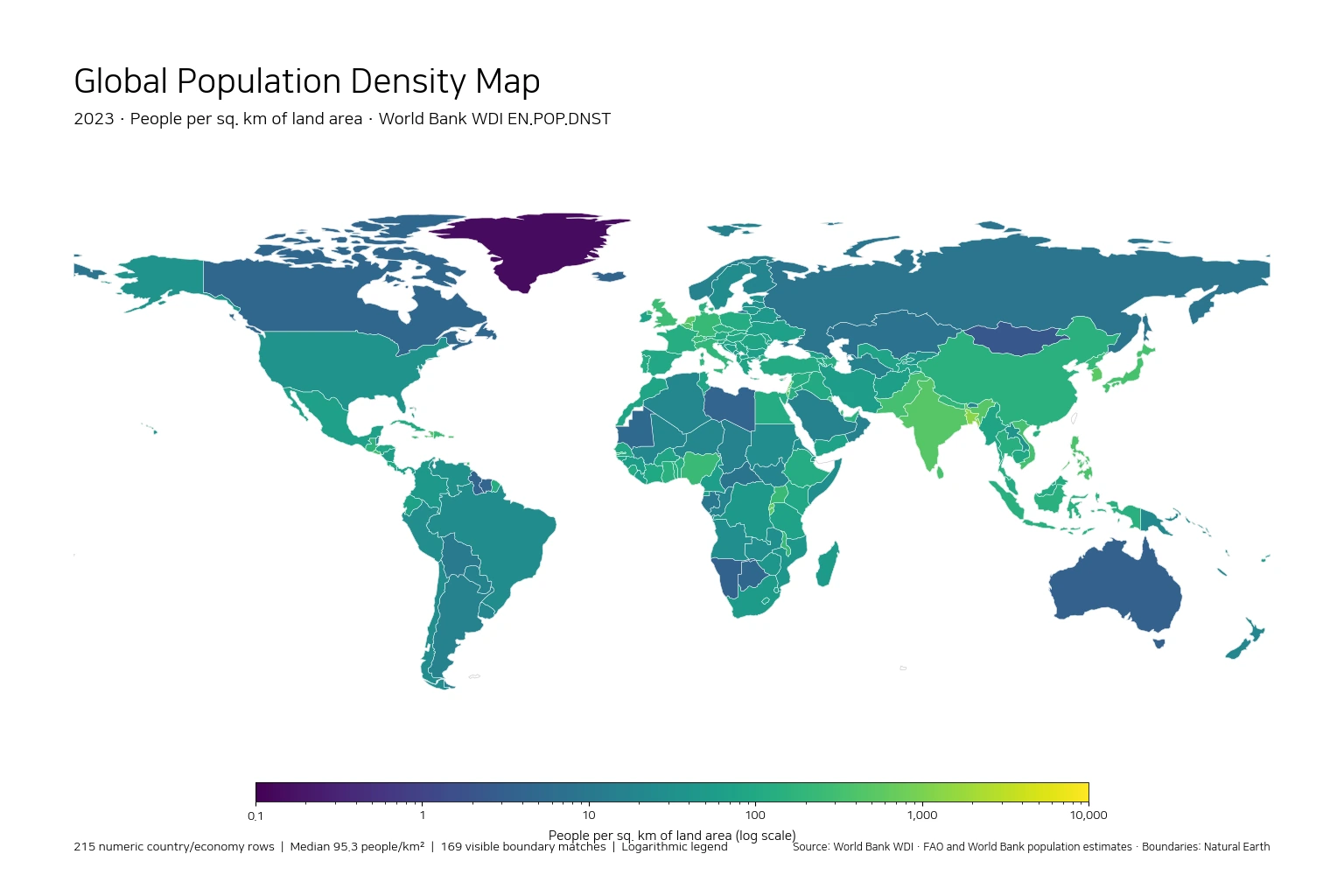
The 2023 global population density map reveals a starkly uneven distribution of people across land areas. While the median country hosts roughly 95 people per square kilometer, the average jumps to over 450 due to a handful of extremely dense territories.
The Distortion of Extreme Values
A logarithmic color scale is essential for visualizing this data because a linear scale would make most nations appear similarly sparse. The dataset includes 215 numeric observations, yet the mean is heavily skewed by outliers like Macao SAR (20,569.7 people/km²) and Monaco (18,692.9). These microstates dominate the upper tail, pushing the average far above the typical experience of the majority. Only 11 economies exceed 1,000 people per square kilometer, with five surpassing 2,000, illustrating why national averages often fail to represent actual living conditions or urban crowding.
Contrasts Between Mega-Nations and Sparse Regions
Large economies demonstrate that population size does not dictate density. The United States averages just 36.8 people per square kilometer, while Canada and Australia hover near 4 and 3.5 respectively. Conversely, smaller nations like Bangladesh (1,319) and South Korea (529.8) sit in much denser bands. At the other extreme, Greenland records a mere 0.14 people per square kilometer. It is critical to remember that these national figures compress complex realities; a low national density does not imply uniform rural settlement, nor does high density guarantee urban congestion across an entire territory.


0 댓글